We’re starting our own marketing motion, and we made a deliberate choice: organic first, paid second. Two honest reasons drove it. One is discipline: content compounds, ads burn. The other is the one most teams skip — you cannot prove ads are working without an organic baseline to compare them against. So step one wasn’t a campaign. It was instrumentation. (When we turn on lead capture, email, and paid campaigns, we’ll be able to prove exactly what each one adds — that’s Part 2, and it’s coming.)
This post is about the first layer: can we be seen, and can we turn that visibility into action? We built it on Clarissi — the same platform we sell — because the most honest thing a company can do is use its own product for something that actually matters.
The problem with “just do your weekly SEO”
The advice is everywhere: spend at least 120 minutes on SEO and you’ll pull ahead of everyone who doesn’t. It’s good advice. Almost nobody with a two-hour marketing budget follows it — because assembling the data eats the two hours before a single decision gets made. Search Console in one tab, analytics in another, the site itself in a third. By the time it’s all in front of you, the 120 minute window’s closed.
And most of what people do assemble is vanity. Rankings and raw traffic feel like progress, but they answer the wrong questions. The two that matter are narrower: are we visible for the terms that actually convert, and which of the pages that get seen produce any action at all? Rankings are a means. Ranking for terms that turn into customers is the job.
What we did: model organic search like an operation
We treated our own SEO the way we’d treat any customer’s operation. We connected Google Search Console — how we show up in search — and Google Analytics — what people do after they click — as data sources the platform reads directly, and the weekly view compiles itself. No more four-tab archaeology.
There’s a two-layer way to think about the whole motion, and it maps onto our organic-first order. The visibility layer — impressions, click-through rate, position, are we being seen — is this post. The value layer — leads, cost per lead, email revenue, eventually paid spend — is Part 2. You build the visibility view first because it’s what tells you where the value will come from.
We authored the dashboard by describing it
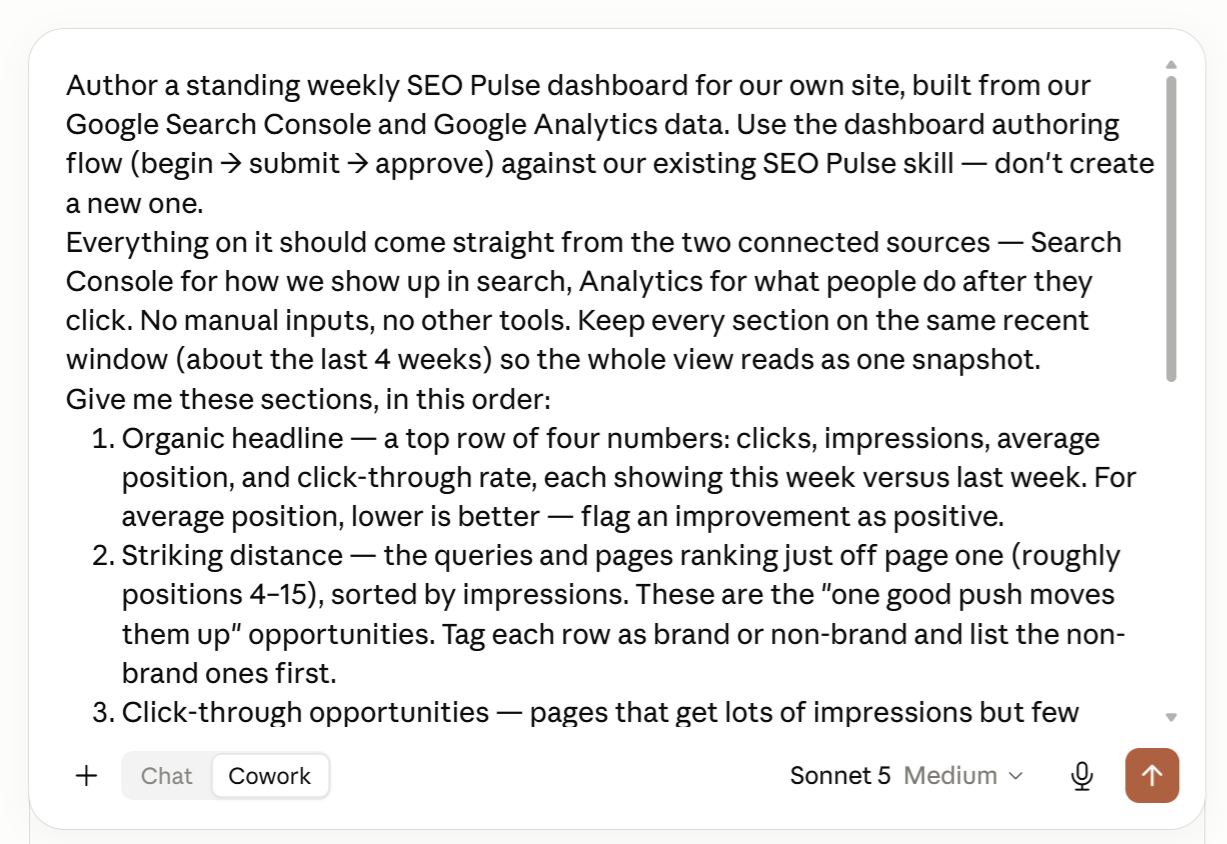
We didn’t configure a dashboard. We told the AI what a good SEO week looks like — striking-distance queries, click-through-rate test candidates, money pages — and it authored the view against our real data. Then we froze it.
Here’s the part that is the actual “we are the experts in AI” claim: the dashboard used an LLM exactly once, at authoring. Every weekly refresh after that re-renders at zero model cost. That’s not a small detail. The reason AI bills are exploding across the industry is that most setups re-read everything and re-run a model on every request. The expertise is knowing where AI belongs: you use it once to build the dashboard, and never again to keep it running. It’s the difference between a tool that costs more every week and one that doesn’t.
The dashboard: what Google shows us, and what people do next
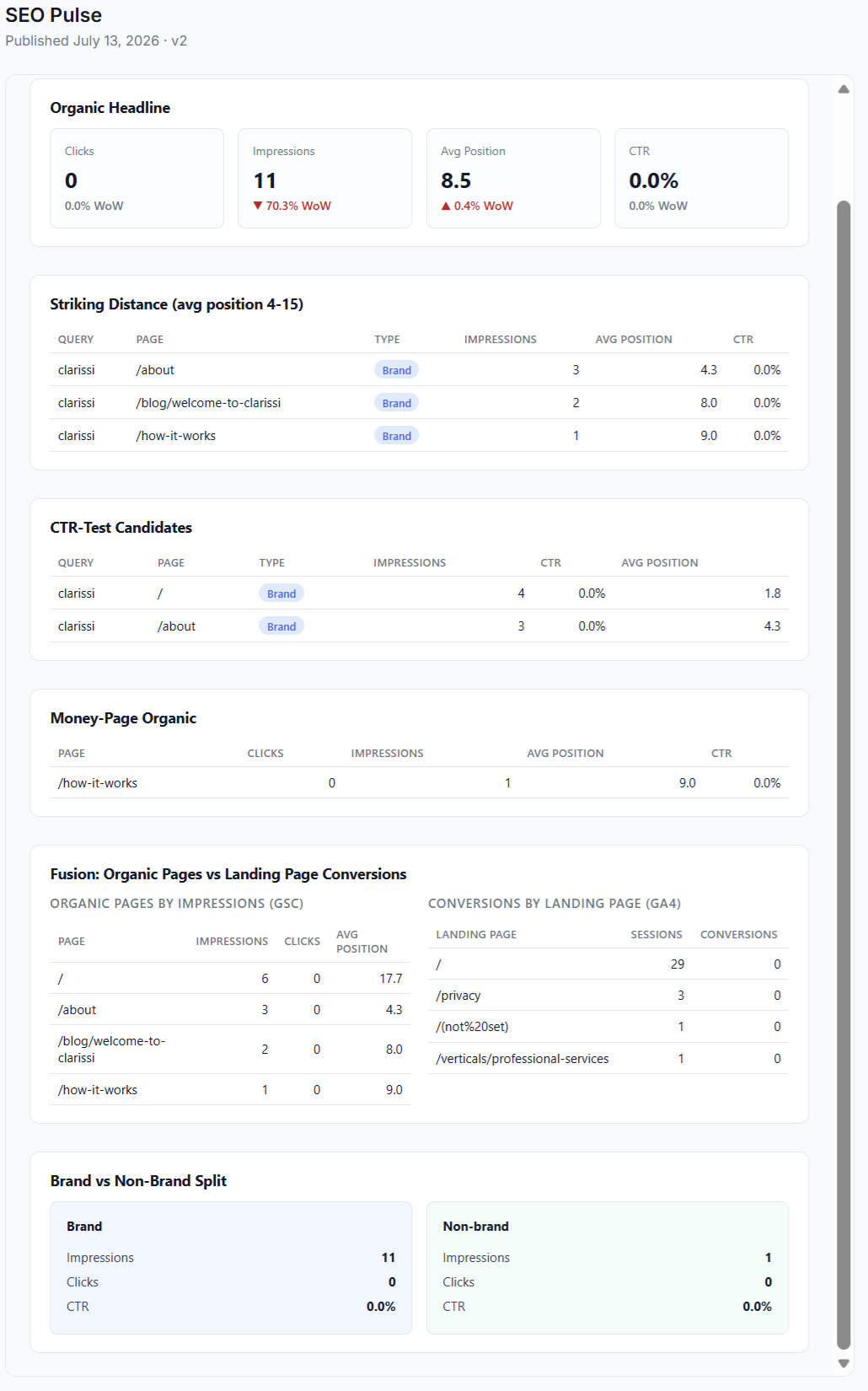
Every section drives a decision. Striking-distance queries — the ones ranking just off page one — tell us where one good push moves a page onto page one. Click-through-rate candidates — high impressions, low clicks — are title and meta rewrites waiting to happen.
The freshest piece is the fusion pair: we joined what Google shows people (organic pages by impressions) to what those people do after the click (conversions by landing page). Most SEO tools stop at the impression. Lining the two up by landing page is how you see whether the pages that get seen are the pages that convert — exactly the cross-system read a single-source tool can’t give you.
There’s also a brand vs. non-brand split, and it’s there deliberately, right now, before we’ve spent a cent on ads. Brand searches mean people already know us; non-brand is where growth actually comes from. Capturing this split before any campaign runs is what will later let us prove whether paid search adds traffic or just buys clicks we’d have gotten for free. That baseline is the whole payoff of going organic-first, and most companies never have it.
And we’ll be blunt about the numbers, because being blunt about numbers is the brand: this is a young domain. Impressions but almost no clicks, click-through rate near zero, nearly all of it brand queries. These are our real week-one numbers — and publishing our zero is the point. This post is part of the plan to move them.
The automations around it: a digest that finds you, an auditor that checks the work
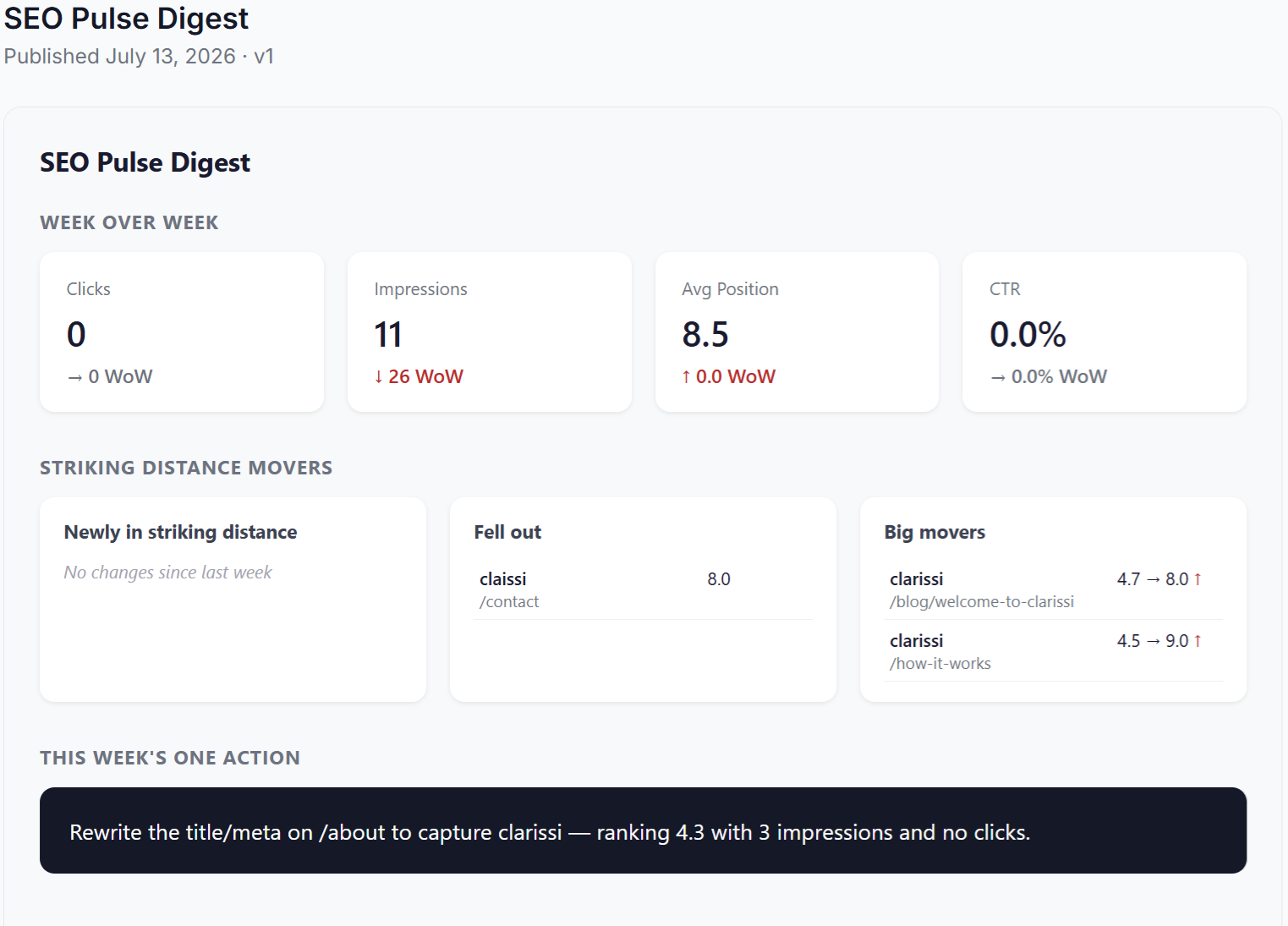
The dashboard is where you go to work. The weekly digest is the thing that comes to you. It’s a distinct artifact — three sections, delivered by email every Monday: this week versus last week, what entered or fell out of striking distance since last week, and one prescriptive sentence naming the single highest-leverage move. That last line — “Rewrite the title/meta on /about to capture clarissi — ranking 4.3 with 3 impressions and no clicks” — is the whole two-hour SEO habit compressed into one email you can act on before your coffee’s cold.
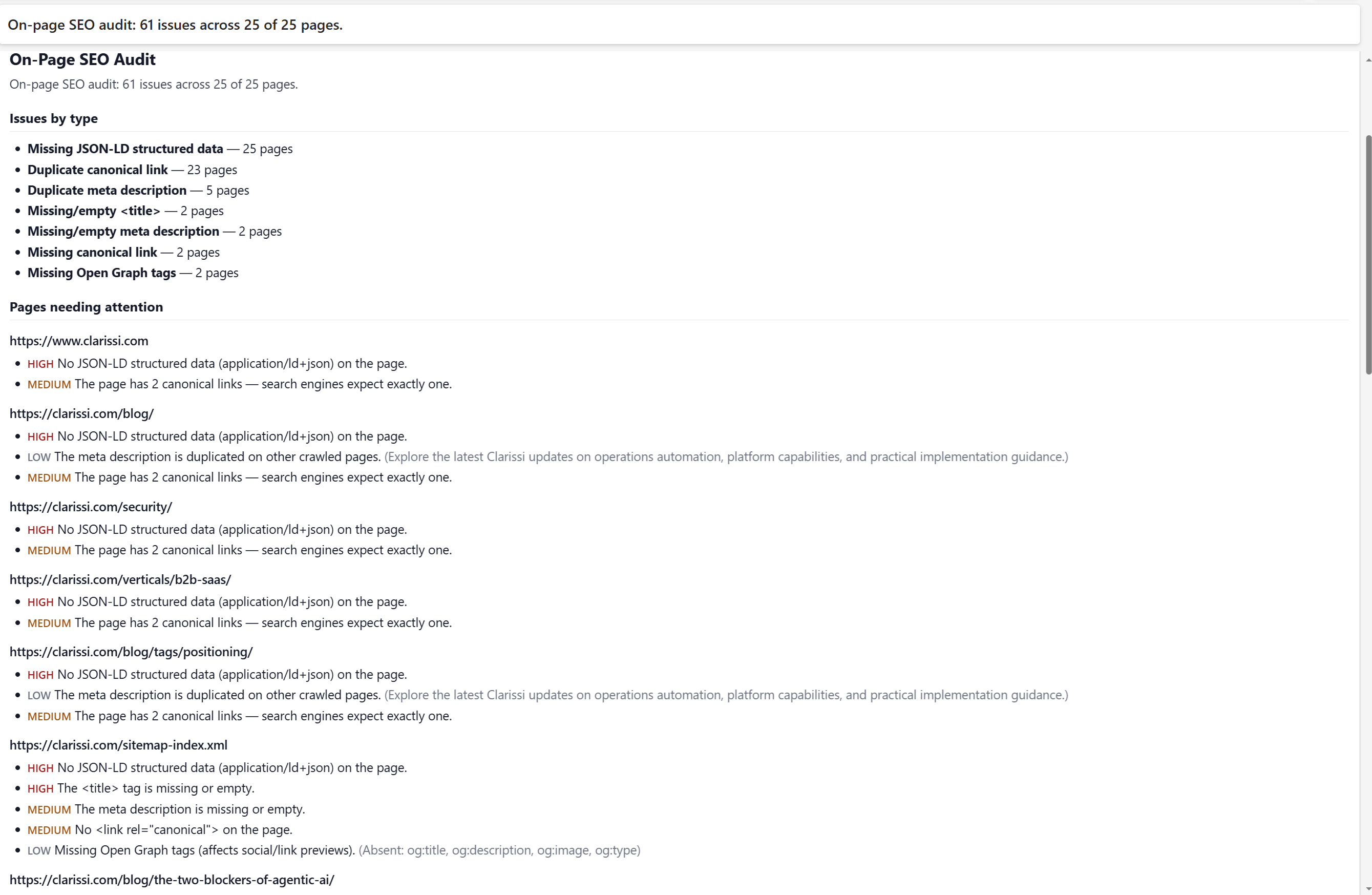
The second automation is an on-page auditor. It crawls every page and emails a prioritized report. Its first pass flagged 61 issues across all 25 pages — missing structured data, thin titles and meta descriptions, canonical and Open Graph gaps. We shipped the fixes it surfaced and re-ran it: the follow-up crawl came back at zero. The auditor is the measure of its own fix.
One thing is true of both, and it matters: they surface and draft — they never touch the site. You see exactly what each one found, and you stay in control of what gets changed. That’s the same trust boundary we build for every customer: nothing acts on your operation that you can’t inspect or constrain.
The whole triad, on our own business
That’s the pattern, run end to end on ourselves: automate the work (the digest and the auditor), visualize the data (the SEO Pulse dashboard), analyze what’s next (striking-distance queries and the weekly one action). One platform, one model of how the operation works, three uses — the same thing we’d point at your funnel, your inventory, or your support queue.
This is the visibility layer. In Part 2, we turn on lead capture, email, and paid campaigns on top of it. And because we built the organic baseline first, we’ll be able to prove exactly what each one adds. If you want to see what this approach would surface in your operations, that’s what an Assessment is for.